Define the correct result
Describe an observable outcome, not an aspiration.
 Cardona CT LabAI Tooling · Design & Accessibility
Writing
Cardona CT LabAI Tooling · Design & Accessibility
Writing
Friction Inversion / Systems Method
Designing for friction across time.
Friction Inversion begins with a simple proposition: correct behavior should be the path of least resistance. But every successful intervention changes the behavior around it. That behavior changes the system. The altered system creates new friction.
Removing friction is not the end of the design. It is the beginning of a new system condition.
The original Friction Inversion method helps identify the correct result, locate resistance, and move that resistance away from the desired path. It is intentionally practical. It asks what the system can remove so a person no longer has to compensate for poor structure with memory, repetition, or effort.
That intervention is never neutral. A better default increases adoption. Automation increases volume. A clearer workflow changes who participates. A successful tool creates dependency. What worked at ten uses may become the source of pressure at ten thousand.
The hill moves because the people, incentives, scale, and information around it move.
Ray Dalio's historical work in Principles for Dealing with the Changing World Order offers a useful modeling discipline: observe recurring forces, distinguish determinants from symptoms, test principles against prior cases, monitor leading indicators, and protect against being wrong.
Friction Inversion operates at a different scale. It turns a system diagnosis into a designed intervention. Dalio helps identify forces moving the hill. Friction Inversion reshapes the path across it.
| System analysis | Friction Inversion |
|---|---|
| Find recurring determinants. | Translate determinants into design conditions. |
| Study cycles and leading indicators. | Measure whether friction is accumulating again. |
| Backtest principles. | Test the intervention against prior failures and edge cases. |
| Protect against model error. | Add reversibility, human review, and safe failure. |
The expanded method keeps the original inversion at its center, then surrounds it with observation, evidence, and rebalancing.
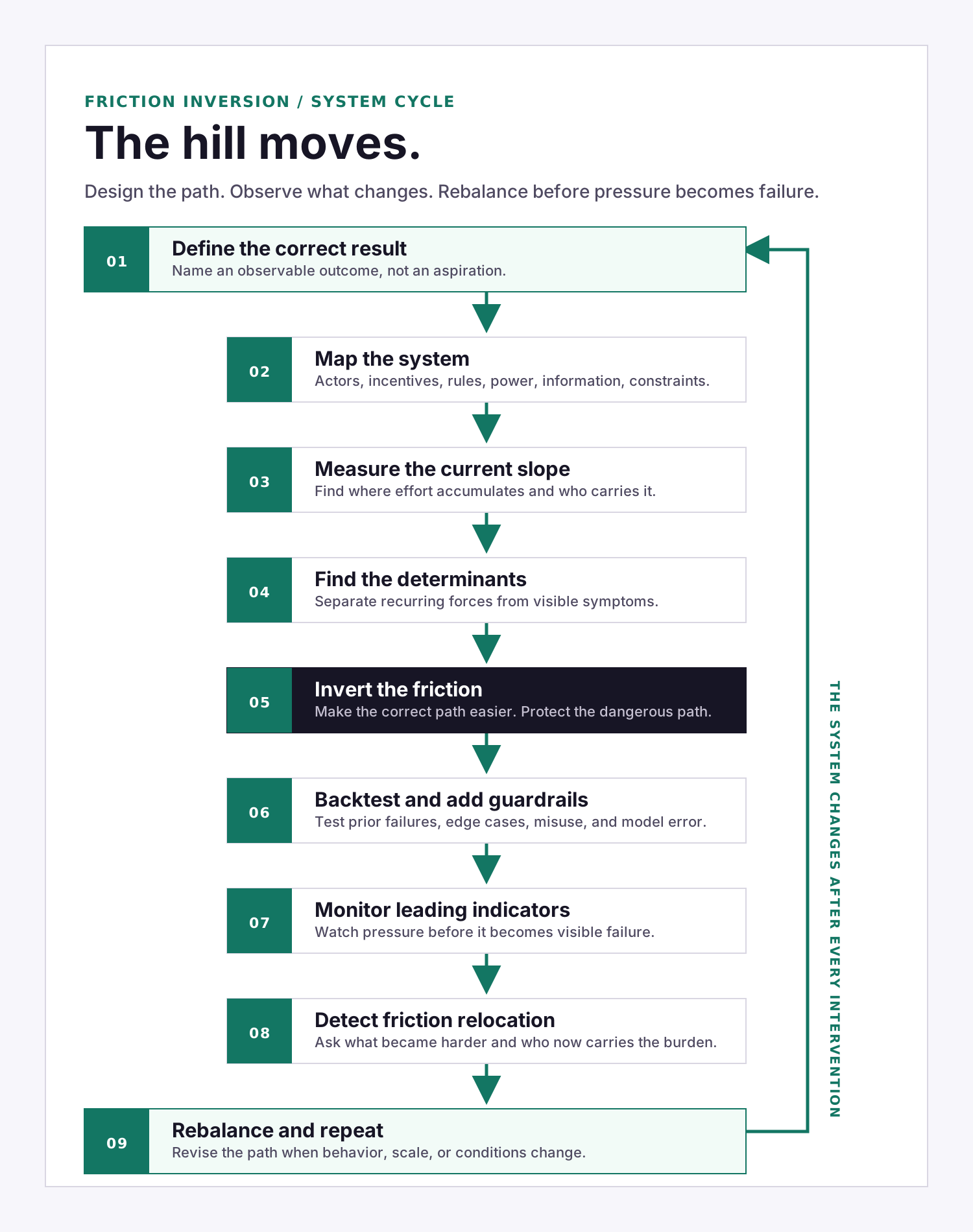
Describe an observable outcome, not an aspiration.
Document actors, incentives, rules, information, dependencies, constraints, and power.
Find where cognitive, procedural, technical, financial, social, emotional, physical, and temporal effort accumulates.
Separate forces that repeatedly produce the problem from symptoms that merely reveal it.
Make the correct path easier and place deliberate resistance where it protects people or the system.
Apply the design to previous failures, edge cases, accessibility needs, adversarial use, and missing information.
Watch pressure before the final outcome visibly fails.
Ask what became harder, where the burden moved, and who carries it now.
Revise the path when behavior, incentives, scale, or the definition of correct changes.
The cycle needs a memory. The Friction Ledger records what was removed, where it moved, who now carries it, what evidence supports the change, and what signal should trigger another review.
The required question:
What became harder because we made this easier?
This prevents invisible burden transfer. An automated workflow may reduce user effort while increasing maintenance work. A simplified interface may hide uncertainty. A helpful default may weaken informed choice. Those costs belong in the design record.
PlantForge provides an unusually clean test of the cycle. The correct result is not more sensor data. It is a timely, trustworthy plant-care decision with less cognitive work.
Virtual sensors let PlantOS develop before hardware arrives. Recommendations remain explainable. Watering remains under human control. Sensor disagreement, overrides, unnecessary notifications, and manual corrections can be treated as leading indicators instead of after-the-fact defects.
The project can therefore document not only what gets built, but whether the methodology correctly predicts where friction will move.
Friction is historical, cyclical, and political. Removing effort is not automatically beneficial. A complete design method must ask who benefits, who absorbs the relocated burden, what behavior the system rewards, what happens at scale, and what protects people when the model is wrong.
Design the path. Observe what the new path changes. Rebalance before pressure becomes failure.